Child Development
Julia Donaldson Audiobooks: Listen Free Online
· Last updated
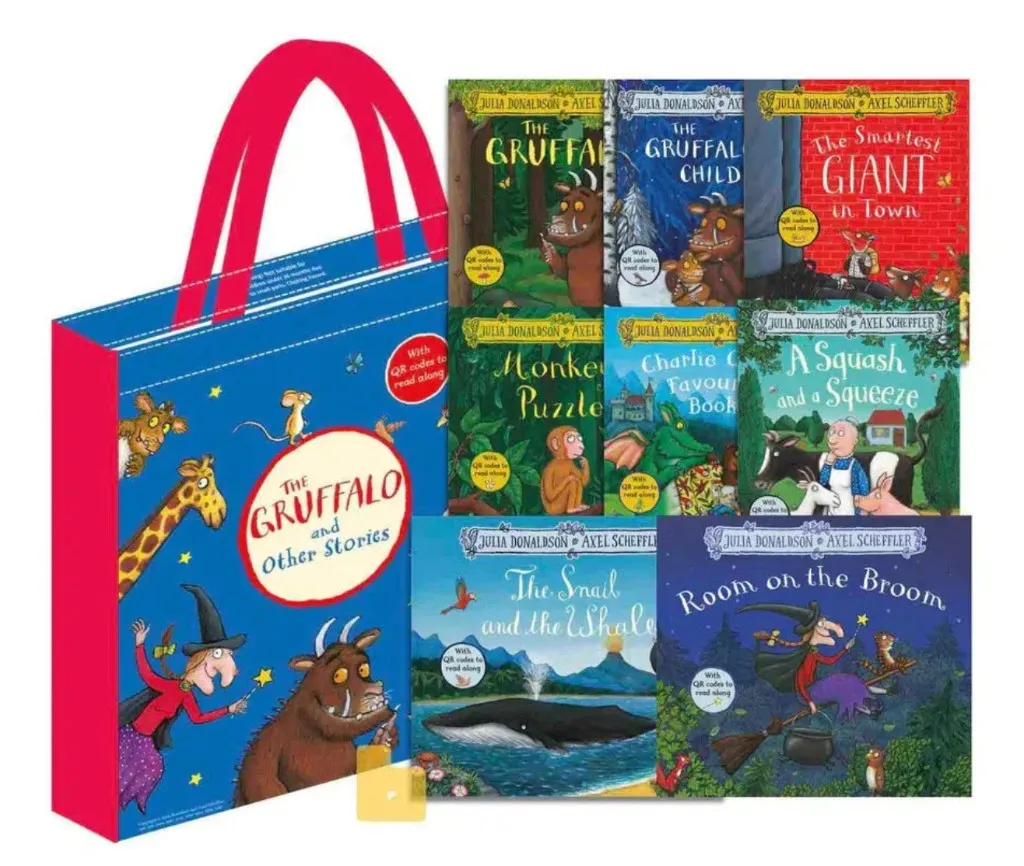
If there is one shelf that turns up in almost every English-speaking household with a preschooler, it is the Julia Donaldson shelf. The Gruffalo, Room on the Broom, The Snail and the Whale — written by Julia Donaldson, illustrated by Axel Scheffler, published by Macmillan Children’s Books.
What far fewer parents know is that Pan Macmillan streams the official audio recordings of these stories for free, on their own dedicated audio site. No app, no trial, no account. Every link on this page goes straight to the publisher’s own player.
Perfect for: the MTR ride to school, the 20 minutes before dinner when nobody has any patience left, long-haul flights, or the wind-down after lights-out.
Listen Now — All Six Stories
Each story below has Pan Macmillan’s own player embedded directly. Press play and it reads itself — no app, no account. If a player looks blank, the publisher is blocking embedding on your browser; the link in each card’s header opens it on their site.
🎧 The Gruffalo
🎧 The Gruffalo
Open on Pan Macmillan ↗Player not loading? Pan Macmillan may block embedding — open it directly.
A mouse takes a walk through a deep dark wood and talks his way past a fox, an owl and a snake by inventing a monster — then meets the monster. The one that started everything, and still the best-constructed picture book of the last thirty years. First published in 1999 and reported to have sold well over 13 million copies worldwide.
Best for: ages 3–7 · Big idea: cleverness beats size
🎧 The Gruffalo’s Child
🎧 The Gruffalo's Child
Open on Pan Macmillan ↗Player not loading? Pan Macmillan may block embedding — open it directly.
The sequel, from 2004. The Gruffalo’s daughter sneaks out into the snow to find the Big Bad Mouse her father warned her about. Same rhythm, same trick, reversed — which makes it a genuinely satisfying second listen rather than a rehash.
Best for: ages 3–7 · Big idea: curiosity, and what parents’ warnings actually do
🎧 Room on the Broom
🎧 Room on the Broom
Open on Pan Macmillan ↗Player not loading? Pan Macmillan may block embedding — open it directly.
A witch keeps dropping things, keeps picking up passengers, and the broom keeps getting more crowded — until a dragon turns up. The cumulative structure (“Is there room on the broom for a dog like me?”) makes this the easiest one for a two-year-old to start joining in with.
Best for: ages 2–6 · Big idea: everyone has something to contribute
🎧 The Snail and the Whale
🎧 The Snail and the Whale
Open on Pan Macmillan ↗Player not loading? Pan Macmillan may block embedding — open it directly.
A tiny sea snail with an itchy foot hitches a ride on the tail of a humpback whale, sees the whole world, and then saves the whale’s life. The most lyrical of the six, and the one that holds up best for older children — there is real geography and real awe in it.
Best for: ages 3–8 · Big idea: small does not mean useless
🎧 The Smartest Giant in Town
🎧 The Smartest Giant in Town
Open on Pan Macmillan ↗Player not loading? Pan Macmillan may block embedding — open it directly.
George buys a smart new outfit, then gives away his tie to a giraffe, his shirt to a goat, his shoe to a mouse family, and ends up back in his old sandals and patched gown — happier. The repeated song (“My tie is a scarf for a cold giraffe…”) is the hook children latch onto.
Best for: ages 3–7 · Big idea: generosity, and being pleased with what you already are
🎧 Monkey Puzzle
🎧 Monkey Puzzle
Open on Pan Macmillan ↗Player not loading? Pan Macmillan may block embedding — open it directly.
A little monkey has lost his mum, and a well-meaning butterfly keeps guessing wrong — an elephant, a snake, a spider — because she does not understand that babies look like their parents. Quietly the best of the six for a child working through separation anxiety.
Best for: ages 2–6 · Big idea: describing what you need, and being found
Note on autoplay: each player above is Pan Macmillan’s, embedded from their site, so the six run independently — one finishing does not start the next. If you want a hands-free run of several stories back to back — the nap-time use case — our Pip and Posy and Bizzy Bear pages have a continuous playlist player with autoplay built in.
Why Rhyming Stories Do More Than Entertain
This is not just “screen-free content.” There is a specific, well-replicated reason Julia Donaldson’s books earn their place in a language-learning home, and it is the rhyme.
Rhyme awareness predicts later reading. In a landmark longitudinal study, Bryant, MacLean, Bradley and Crossland followed children from age three and found that early sensitivity to rhyme and alliteration predicted reading and spelling ability years later, even after controlling for IQ and social background (Bryant et al., 1990, Journal of Child Language). Knowing that mouse and house sound alike is the first step towards noticing that they are also spelled alike.
Donaldson’s verse is unusually well-built for this. She writes in tight, regular metre with a predictable rhyme scheme, which means a child can predict the next word before it arrives. That prediction — filling in “…there’s no such thing as a gruffal-oh!” — is phonological processing happening on its own, for fun.
Repetition is a feature, not a bug. Parents often worry about the tenth listen of the same story. The research points the other way: Horst, Parsons and Bryan found that three-year-olds learned and retained more new words from repeated readings of the same storybook than from the same number of readings spread across different books (Horst et al., 2011, Frontiers in Psychology). If your child wants The Gruffalo again, that is the vocabulary sticking.
Listening comprehension is half of reading. Under the widely used “simple view of reading” (Gough & Tunmer), reading comprehension is the product of decoding and language comprehension. Audiobooks do nothing for decoding — but they build the other half, and they build it for children who cannot yet decode a word.
One Honest Caveat
Audio is a supplement, not a substitute. The strongest evidence in early literacy is for dialogic reading — an adult reading with a child, asking questions, following what the child points at. A recording cannot ask “what do you think happens next?” and cannot notice that your child has gone quiet at the scary page.
So the useful frame is:
- Shared reading — the high-value activity. Protect it.
- Audio stories — excellent for the times shared reading is not possible: commuting, cooking, illness, the second parent’s turn that never came.
- Screen adaptations — enjoyable, and the animated versions of these books are genuinely good, but they do the imagining for the child.
For Hong Kong families in particular, there is a second use: many households here run Cantonese or Mandarin at home and English at school. Audio gives repeated, correct, native-speed English input without asking a parent to perform in a second language every night. That exposure is real, and it costs nothing.
How to Actually Use These
A few things that work better than just pressing play:
- Read the book once first, then listen. Familiarity is what lets a child follow audio without pictures.
- Let them hold the book while it plays. Turning pages at the right moment is genuine early print awareness.
- Pause before the rhyme. Stop the audio one word early and let them supply it. This is the phonological workout, and children love it.
- Same story, several nights running. Resist the urge to rotate. Repetition is where the vocabulary lands.
- Keep it short at first. Two- and three-year-olds may only manage a few minutes of audio-without-pictures. That grows quickly.
About Julia Donaldson and Axel Scheffler
Julia Donaldson was a busker and songwriter before she was an author, which explains a great deal about the metre — the words are written to be said out loud, not read silently. She was UK Children’s Laureate from 2011 to 2013. Axel Scheffler, her long-time collaborator, is a German-born illustrator based in London; he also illustrates the Pip and Posy series for Nosy Crow.
Age range: roughly 2–8, with the sweet spot at 3–6 Publisher: Macmillan Children’s Books (Pan Macmillan) Free audio: audio.panmacmillan.com Books available at: Bookazine, Eslite, Swindon, Amazon, and most Hong Kong bookshops
Frequently Asked Questions
Are these Julia Donaldson audiobooks really free?
Yes. Pan Macmillan — the publisher — hosts these recordings on their own audio site as free listening. Every link on this page points at the publisher’s official player. Nothing is hosted here and nothing is pirated.
What age are Julia Donaldson books for?
Broadly 2–8. Room on the Broom and Monkey Puzzle work from around two because of their repeating structure; The Gruffalo and The Smartest Giant in Town land best from three; The Snail and the Whale keeps working up to seven or eight.
Which Julia Donaldson book should we start with?
Room on the Broom for the youngest listeners — the cumulative “is there room on the broom for a…” pattern is the easiest to join in with. The Gruffalo if your child is three or older. Monkey Puzzle if separation anxiety is the current issue at home.
Can my child listen without the book in front of them?
Eventually, yes — but it is much easier if they already know the story. Read the physical book two or three times first, then use the audio. Listening without pictures is a real skill and it takes a few weeks to build.
Do audiobooks count as reading?
Not as decoding practice — a child cannot learn letter-sound correspondences by listening. But listening comprehension is one of the two components of reading comprehension, and audiobooks build vocabulary, sentence structure and story sense. Treat them as half the job, done well.
Is there a Gruffalo film?
Yes — the BBC animated The Gruffalo (2009) and The Gruffalo’s Child (2011), plus animated versions of Room on the Broom (2012) and The Snail and the Whale (2019). They are good. They are also not a replacement for the book or the audio, because the animation does the imagining.
Explore More Free Audio Stories
- Pip and Posy audiobooks — gentle friendship stories illustrated by Axel Scheffler, with a continuous autoplay player
- Bizzy Bear: Everyday Adventures — interactive board books for ages 1–4
- Music, rhythm and speech development — why rhythm is doing more for language than it looks like
- Toddler speech red flags — when listening and talking are not developing as expected
All audio © Pan Macmillan and streamed from their official site. This page is an unofficial listening guide for parents and caregivers; nothing is hosted here.
Keep Reading
Positive Discipline: What Works Better Than Time-Out
August 16, 2026
Toddler Speech Delay: Red Flags and When to Get Help
August 16, 2026
Introducing Allergens to Baby: What the Evidence Says
August 16, 2026
Separation Anxiety by Age: What's Normal and When to Worry
August 13, 2026